
Development
Ball handling drills that actually transfer to games.
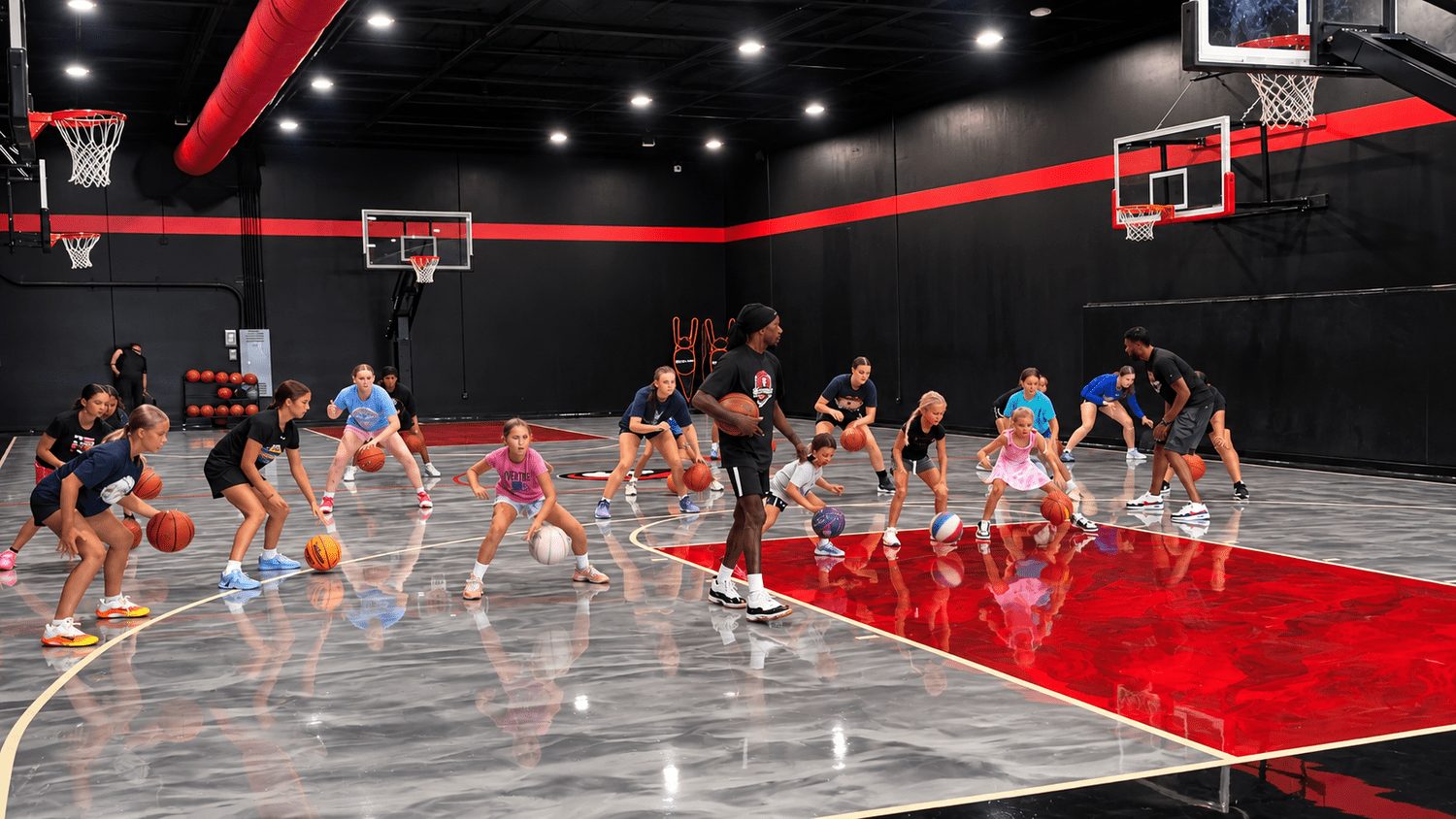
Every parent has seen it. A kid looks like a wizard in the drill line, pounding two balls, weaving through cones, and then the game starts and the first defender takes the ball like it was a gift. The drill was never the problem. The transfer was. Most dribbling work teaches kids to dribble. Games ask them to do something much harder.
The cone problem
Cones do not reach. Cones do not read your eyes, cut off your strong hand, or speed you up on purpose. A kid who only dribbles around cones learns one habit: looking down at the ball while he performs moves nobody asked for. In a game, the ball has a job. It gets you past a defender, into space, to a finish, or to a teammate. If a drill never makes the dribble do one of those jobs, the drill is entertainment.
Stationary work has its place. A young kid needs the basics: pound dribbles with both hands, crossovers in place, control while his eyes are up. But that is the foundation, not the house. Too many programs live on the foundation for years because it looks organized. It does not make ball handlers.
What actually transfers
Eyes up, always. A ball handler who is watching the floor can see the help defender coming and the teammate cutting. We coach the eyes before we coach the moves, because that order is what games demand.
Change of pace beats change of direction. The dribble move that works in games is rarely the fanciest one. It is the one paired with a stop, a hesitation, a burst. Defenders guard rhythm. Teach a kid to break his own rhythm and he will beat defenders with simple moves for years.
The weak hand has to be a real hand. Defenders figure out a one-handed dribbler in two possessions and sit on his strong side all game. Weak hand work is not extra credit. It is half the job.
And every sequence has to end somewhere. A move that ends in a finish at the rim or a pass to an open man is a basketball play. A move that ends back at the top of the key, where it started, is a performance. In our basketball development sessions in Fort Myers, dribbling work is always tied to an ending: score it, or find the teammate the defense gave up.
A defender changes everything, on purpose
The fastest way to find out if a drill transfers is to add a defender. Not full pressure on day one. A coach with a pad, a teammate shadowing, then live one on one with an advantage, then the real thing. Each step asks the handler to protect the ball, read a body, and decide. That decision is the skill. The dribble is just the tool.
Here is what it looks like when the handle holds up in a real game. This is one of our league players, and there is no cone in sight:
What parents should watch for
If your child's dribbling work never includes a defender, never asks him to look up, and never ends in a finish or a pass, it is not building a ball handler. It is building a drill performer. The fix is not more drills. It is better ones, inside a program built on player development from start to finish, where the same coaches who teach the handle on Tuesday watch it hold up in his game on Saturday.
Bring him in for a free trial and watch a session. You will see the difference in about ten minutes, and so will he.
Free Trial
Build a handle that survives a defender.
Book a free trial session. We assess where your athlete stands and build the plan for him, not a template.